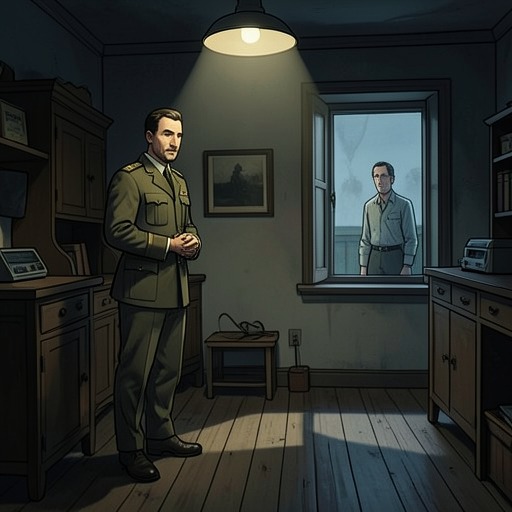
The unnamed narrator
The SympathizerThe unnamed narrator is a spy embedded among the South Vietnamese soldiers and evacuees he has been sent to watch, as well as an aide-de-camp who serves as an interpreter of American culture for The General. His defining capacity is to see an issue from both sides: what first appears to him as a talent becomes a danger because it is difficult to set aside. Writing from isolation, he turns that divided vision into both the subject and the method of his confession.
Identity and Double Vision
The unnamed narrator introduces himself as “I AM A SPY, a sleeper, a spook, a man of two faces.” He adds that he is also a man of two minds, able to see issues from opposing sides. At the beginning of his confession, he takes some pride in this faculty, regarding it as perhaps his only talent. But he also questions whether a capacity that cannot be switched off is truly a talent: it may use its possessor rather than serve him. The tension between virtue and hazard establishes the problem that runs through his account—his ability to understand more than one side is also what makes uncomplicated allegiance difficult.
Spy and Aide to The General
In April, while awaiting the war’s end in a walled villa where he has lived for five years, the narrator occupies a position between military and cultural worlds. As The General’s aide-de-camp, he attends meetings with Americans because he is the staff officer most fluent in American culture. His command of English extends beyond formal speech to American popular references and idioms; he can discuss baseball, Jane Fonda, and the Rolling Stones or the Beatles, and can be mistaken for an American over the telephone.
That fluency does not make him feel accepted. When Americans meet him in person, they are astonished by his appearance and ask how he learned to speak English so well. He resents the expectation behind the question: Americans anticipate that his countrymen will speak little English, pidgin English, or accented English. His command of their language becomes a way to contest that assumption, and he takes pride in speaking and writing it with precision. In his dealings with Claude, he understands the insult in Claude’s description of the ambassador and can follow the euphemisms surrounding the evacuation even as The General confronts Claude over the abandonment of the city.
Bastardhood and Sympathy
The narrator connects his tendency to identify with people across enemy lines to his status as a bastard. In his confession to The Commandant, he explains that he cannot easily call the southern soldiers and evacuees he was sent to spy on “them,” because he has spent nearly his whole life among them and sympathizes with them. He credits The narrator’s mother with teaching him that the boundary between “us” and “them” can be blurred. The circumstances of his birth—outside marriage, after the boundary between a maid and a priest was crossed or permitted to be crossed—make that blurring personal rather than merely political.
His origins also shape his view of marriage and bachelorhood. Uncomfortable with the prospect of marrying, and regarded by many families as an unsuitable match, he describes bachelorhood as both freedom and a practical fit for his underground life. He likens himself to a mole, better able to burrow alone. The image joins social exclusion to covert work: the solitude imposed by his status also seems to suit the solitary habits of a spy.
Confession and Narrative Position
The narrator’s account is addressed to The Commandant, whose notes have prompted him to explain why he uses collective language for people he was assigned to treat as enemies. The confession begins in the villa and speaks from the later confinement of an isolation cell. He compares the private room he had in the villa with his cell in the camp, emphasizing that privacy—not cleanliness—is what he needs in order to write.
He describes the confession as unusually honest and says that he does not understand why he is imprisoned. A three-by-five-meter cell gives that uncertainty a physical measure; the possibility that he is already condemned makes the decision to explain himself in his own style more urgent, not less. His earlier life as a sleeper agent had required him to live in code. Decoding Man’s dispatches and encoding his own in invisible ink were among the spy’s tasks that could lull him to sleep, even as the rest of that life left him afflicted with insomnia. The written confession reverses that practice: instead of keeping every message brief and coded, he attempts to make his divided life legible to the authority judging him.